
Chartered Physiotherapy

Donnybrook Sports Medicine Blog

Patient Info & Resources:

Posts tagged Sports Medicine
Technology in Sports Medicine Rehabilitation: A Data-Driven Approach

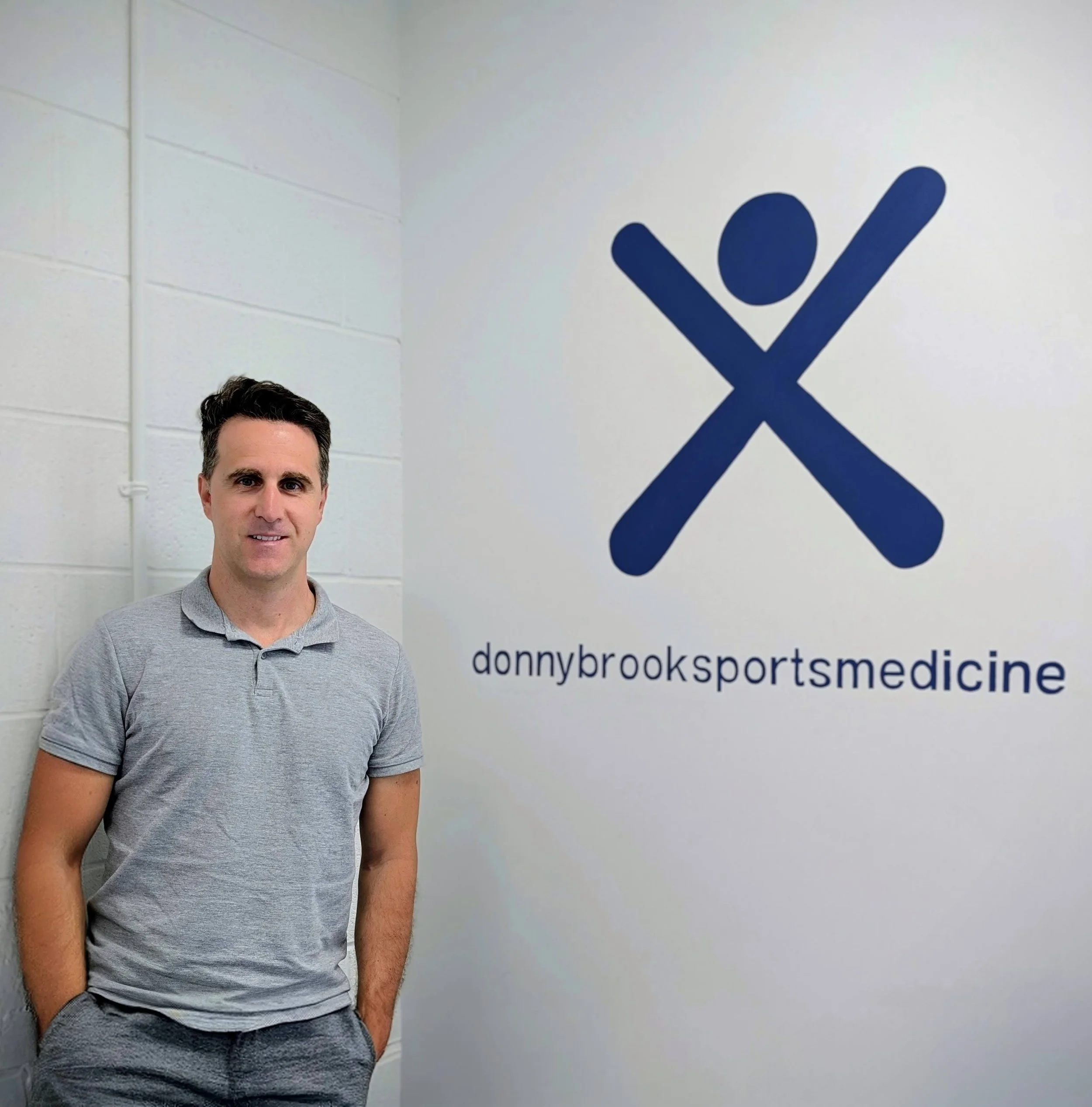
Eduard Mias, Clinical Specialist Physiotherapist at Donnybrook Sports Medicine, outlines the role of technology in optimising rehabilitation outcomes.
Background
Ed has worked in elite sports for approximately 15 years. Following completion of a Masters in Australia, he commenced private practice in London alongside roles at Fulham FC Academy and Chelsea FC. In 2011, he transitioned to full-time elite sport, working with English Institute of Sport and British Athletics, primarily with elite sprinters. He relocated to Dublin in 2019, joining Irish Rugby until November 2025, followed by roles at Ulster Rugby and Man City Football as part of their rehabilitation units.

Advantages of using Technology in Rehabilitation at Donnybrook Sports Medicine
The use of technology can assist and improve clinical examination and exercise prescription during rehabilitation. Using the latest devices and techniques help patients and athletes to return to their sport or function in as short a time-frame as possible, while ensuring that essential rehab criteria are met. This is often referred to as a ‘criteria based’ rehab program. Donnybrook Sports Medicine utilises the VALD ForceDecks and Dynamo systems as well as sEMG sensors to guide rehabilitation. The clinic's approach focuses on data-driven decision-making, providing athletes with clear criteria to progress through each stage of rehab and return to activity as quickly as possible. Surface EMG uses sensors placed on the skin to provide objective quantification of muscle activity, confirming that observed improvements correlate with measurable changes. Manual resistance testing may appear adequate, but without quantification, true progress remains uncertain. Technology also identifies compensatory movement patterns that may not be apparent on visual assessment alone. Athletes may unconsciously adopt strategies to complete tasks suboptimally, increasing re-injury risk.

Clinical Applications
In hamstring injuries, sEMG commonly reveals medial hamstring dominance, with the injured lateral component lagging behind. Without addressing this imbalance, there is significant risk of re-injury when dynamic activities such as running and sprinting are reintroduced. Post-ACL and knee surgery, sEMG serves as an effective visual feedback tool to facilitate muscle re-education, often more effective than self-directed rehabilitation alone. Upper Limb injuries and surgeries such as shoulder surgery can also benefit from identifying imbalances such as a rotator cuff weakness that can lead to long term pain or slower progression with rehab.

Criteria based Rehabilitation & Return to Sports
At the elite level, objective criteria must be met before return to sport. Strength diagnostics align an athlete's capacity with the demands of their activity. For example, running at 5, 7, or 10 km/h requires specific strength thresholds. Data provides certainty that the body can cope with the forces and demands of the intended activity.


Technology enhances rehabilitation by providing certainty, clarity, and objective progression metrics. Rather than relying on subjective improvement, data demonstrates tangible progress from session to session, ensuring athletes return to sport with confidence in their readiness.
To book a consultation for objective testing and diagnosis, you can see current availability and confirm an appointment time here.

ForceDecks @ Donnybrook Sports Medicine

Force Plates / Force decks are a training and medical device used to measure force produced during movement and exercise. Commonly used in research settings to assess movement and strength, there are various companies who supply these devices.

Image of Forceplates at Donnybrook Sports Medicine

In Ireland, the VALD ForceDecks are in use in some of Ireland’s top orthopaedic and sports medicine centres, as well as professional sporting teams. This technology is something that Nathan has been using through professional rugby teams over the past few years.

In January 2025, this exciting technology will become available for use with clients at Donnybrook Sports Medicine. This investment will enable data tracking with progression of rehab and guide decision making for return to play / exercise progression / referral for further evaluation etc.

In addition to the performance measures which can be measured as part of a physiotherapy session or specific testing appointment, VALD technology also incorporates an exercise prescription app which will be available for clients to download, complete exercise programs and track results of ForceDeck testing.

If you are interested in this technology and how it can guide your rehab or enhance your sports performance – please reach out via email or phone call to discuss. Appointments can be booked here.

3 Essentials: Returning to Training

Good job! You are thinking about returning to training or increasing your physical activity - taking the first steps can be easy! While getting back to activity (walking / sports / physical work etc) can be intimidating, this short blog will summaries three essential tips that will help you to return to training with a simple plan.

  1. Progressive Training

  2. Warm Ups

  3. Recovery Hacks

We have all heard the phrase ‘you have to walk before you can run’, but how can we progress our training at the right pace? If starting out on a return to exercise, it is best to complete regular lower intensity training (for example 20-30 mins, every second day) throughout the first week. A good rule for progressing your training is to add about 20% to your overall training, week by week. Twenty minutes will become 45 minutes, within one month!

Start your exercise with a short warm up. This does not need to be complicated (and should not be focussed on stretching!). The best way to warm up your body, is to complete short sets of exercises, which use the muscles you are going to exercise. The target is joint movement, and increasing your heart rate (warming UP!). A great full body warm up is 3 sets of 10: squats on the spot / push ups (can be from knees) / lunges. Spend about five minutes getting through these and then progress with your exercise!

Recovery is key to feeling the benefits of exercise. There are a lot of useful gadgets and supplements that can help to add ‘the 2%’ - but don’t make the mistake of forgetting about the easy 80%. Our bodies need time to rest and repair after exercise, this happens through sleep, hydration, nutrition and load management. If you focus on planning your training load through the week; replacing lost fluids; eating nutrient rich foods and getting the sleep that your body needs, you will already cover the most important 80% of recovery strategies!

Watch this space for more detailed blogs on these topics.
If you would like to stay informed - you can also sign up below for a quarterly newsletter: