
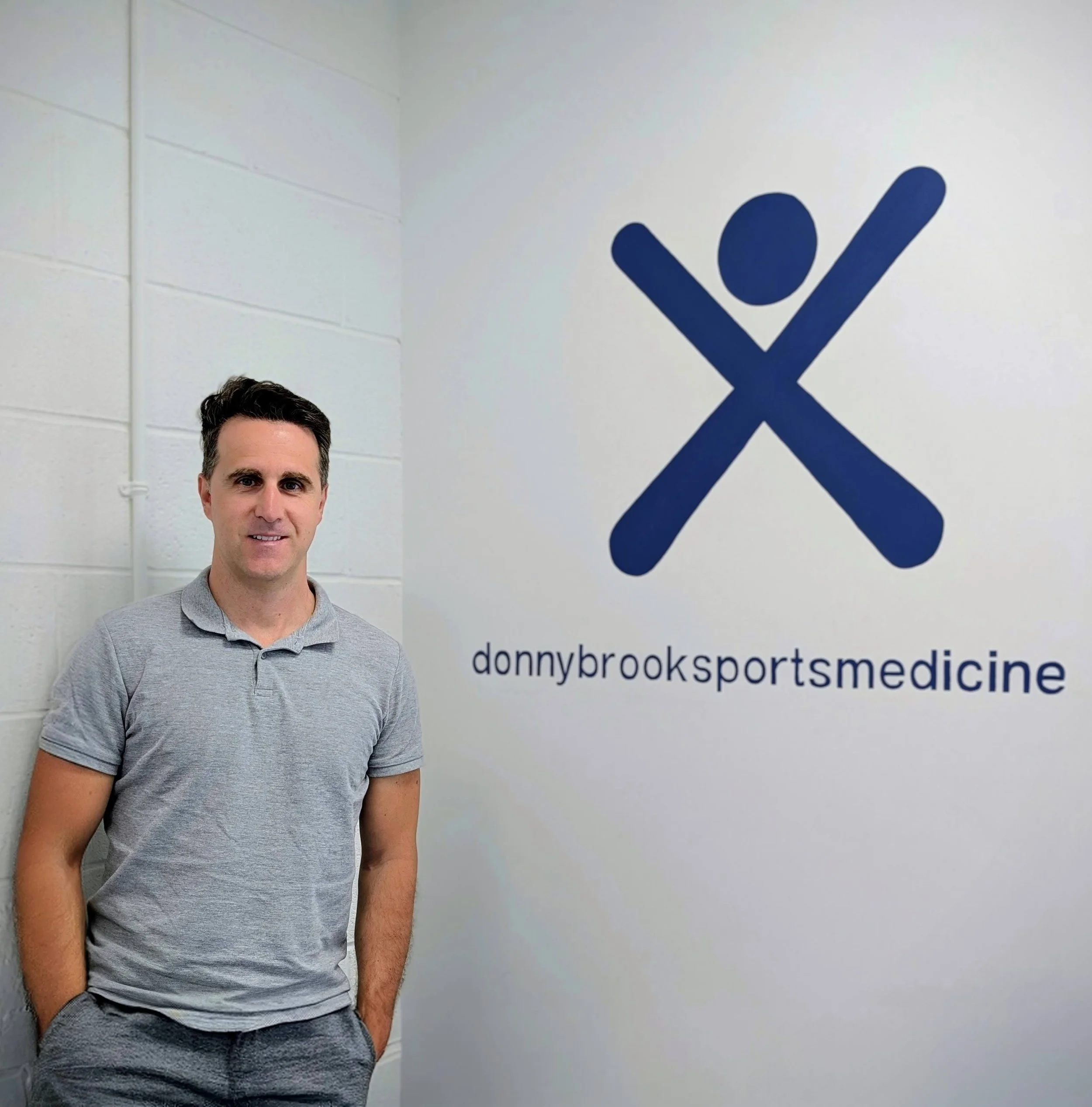
Eduard Mias, Clinical Specialist Physiotherapist at Donnybrook Sports Medicine, outlines the role of technology in optimising rehabilitation outcomes.
Background
Ed has worked in elite sports for approximately 15 years. Following completion of a Masters in Australia, he commenced private practice in London alongside roles at Fulham FC Academy and Chelsea FC. In 2011, he transitioned to full-time elite sport, working with English Institute of Sport and British Athletics, primarily with elite sprinters. He relocated to Dublin in 2019, joining Irish Rugby until November 2025, followed by roles at Ulster Rugby and Man City Football as part of their rehabilitation units.
Advantages of using Technology in Rehabilitation at Donnybrook Sports Medicine
The use of technology can assist and improve clinical examination and exercise prescription during rehabilitation. Using the latest devices and techniques help patients and athletes to return to their sport or function in as short a time-frame as possible, while ensuring that essential rehab criteria are met. This is often referred to as a ‘criteria based’ rehab program. Donnybrook Sports Medicine utilises the VALD ForceDecks and Dynamo systems as well as sEMG sensors to guide rehabilitation. The clinic's approach focuses on data-driven decision-making, providing athletes with clear criteria to progress through each stage of rehab and return to activity as quickly as possible. Surface EMG uses sensors placed on the skin to provide objective quantification of muscle activity, confirming that observed improvements correlate with measurable changes. Manual resistance testing may appear adequate, but without quantification, true progress remains uncertain. Technology also identifies compensatory movement patterns that may not be apparent on visual assessment alone. Athletes may unconsciously adopt strategies to complete tasks suboptimally, increasing re-injury risk.
Clinical Applications
In hamstring injuries, sEMG commonly reveals medial hamstring dominance, with the injured lateral component lagging behind. Without addressing this imbalance, there is significant risk of re-injury when dynamic activities such as running and sprinting are reintroduced. Post-ACL and knee surgery, sEMG serves as an effective visual feedback tool to facilitate muscle re-education, often more effective than self-directed rehabilitation alone. Upper Limb injuries and surgeries such as shoulder surgery can also benefit from identifying imbalances such as a rotator cuff weakness that can lead to long term pain or slower progression with rehab.
Criteria based Rehabilitation & Return to Sports
At the elite level, objective criteria must be met before return to sport. Strength diagnostics align an athlete's capacity with the demands of their activity. For example, running at 5, 7, or 10 km/h requires specific strength thresholds. Data provides certainty that the body can cope with the forces and demands of the intended activity.
Technology enhances rehabilitation by providing certainty, clarity, and objective progression metrics. Rather than relying on subjective improvement, data demonstrates tangible progress from session to session, ensuring athletes return to sport with confidence in their readiness.
To book a consultation for objective testing and diagnosis, you can see current availability and confirm an appointment time here.